
The strand tangle model of nature also yields a model of black holes. For an observer at spatial infinity, black holes are one-sided weaves of strands. Black holes, and all other structures in nature, are made of fluctuating strands of Planck radius:
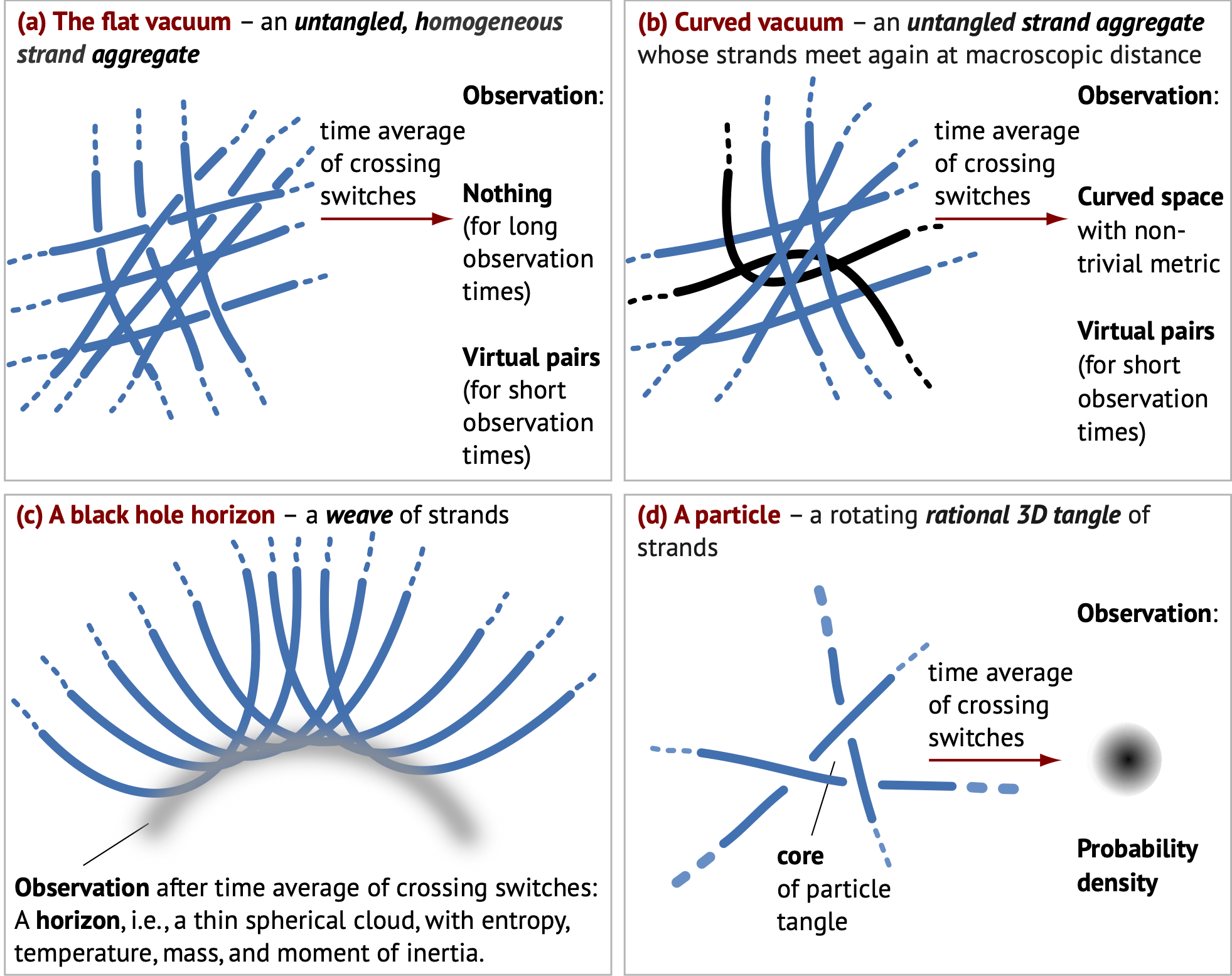
The sketch in the lower left is a flash image of a black hole for an observer at large distance. In reality, the strands fluctuate all the time: their shapes “tremble”. These fluctuations yield the entropy, the temperature and the mass-energy of black holes, as told in various papers and preprints (such as this last one). As mentioned, strands are unobservable, due to their thin radius. Therefore, black holes are spherical. The crossing switches of strands yield Planck’s quantum of action: crossing switches thus produce all physical observables. They are all on the surface of the black hole sphere, where the strands are interwoven.
Strand black holes are fascinating. Because strands yield the thermodynamics of black holes, they yield and imply general relativity, with Einstein’s field equations, as Jacobson showed in 1995. For the same reason, strands realize Verlinde’s entropic gravity. Strands also illustrate why the entropic description and the description with curved space are equivalent. (Rotating particles are show why gravity is also the exchange of gravitons, but we skip this here.)
Strand black holes can rotate, as the wonderful animation by Jason Hise shows:
This is a version of Dirac’s trick, for the case of large numbers of tethering strands. One recalls that strands are unobservable, only crossing switches are observable. Thus, only the black hole is observable, not its tethers. The animation also visualizes the frame dragging effect occurring around the black hole horizon.
Strands imply that the mass of a black hole is located on its horizon. This agrees with their moment of inertia. (And this disagrees with all the sycophants that repeat that black hole mass is located in a “singularity” at their “geometric centre”. It was known already before the strand model that this is not the case.) The moment of inertia I of a black hole is I=MR^2. Black holes thus behave similarly to rotating mass shells, which have the slightly smaller moment of inertia I = (2/3) MR^2, and de facto behave like a rotating massive ring, which has I=MR^2.
Strand black holes also can have an angular momentum. The angular momentum is given by the moment of inertia times the angular velocity. This is interesting, because the maximum angular velocity, for a horizon rotating with surface speed c, is c/R. As a result, using the moment of inertia of black holes, the maximum angular momentum J is cMR, or, in units of mass and using the fact that the radius of extremal rotating black holes is half the non-rotating value, J ≤ GM^2/c. This is the well known angular momentum limit for black holes.
Strand black holes further have a maximum electric charge. In the strand tangle model, electric charge is due to chiral crossings of the strands leaving the central structure. (Each such crossing yields a charge e/3.) Because the average strand length in the horizon is a fraction of the diameter, the number of strands in a black hole is proportional to its diameter. Therefore, the maximum electric charge is also proportional to the black hole diameter. This is a well-known result. Strands yield it automatically.
Strands also imply that black holes have no other quantum numbers, because all other quantum numbers of elementary particles, such as strong charge, weak charge, etc., automatically vanish for black holes. This result is usually summarized by stating that black holes have no hair.
Strands also imply that black holes cannot be smaller than a Planck mass. Smaller strand structures are particles - they have no horizon.
Because black holes have a temperature, they evaporate. Strands imply that evaporating black holes leave no remnants, thus no leftovers. Only elementary particles are remain. This solves a further problem of classical black holes. (And obviously, the strand model of black holes and particles has no problem with information loss.)
In simple words, weaves of unobservable strands of Planck radius automatically yield black holes with all their properties. This implies - but do not tell it anybody else - that strands describe the quantum aspects of gravity.
*
Bibliography:
A simple introduction into the strand description of gravity is this web page. It also contains many experimental predictions about gravity and quantum gravity.
For physicists, the strand tangle model is presented in this publication preprint. The strand tangle model deduces all of general relativity and all of particle physics from just one fundamental principle. A long publication preprint is here.
What a truly insightful article; I'm particularly struck by how the unobservable strand fluctuations, despite their Planck radius, manege to so elegantly yield and imply general relativity, as Jacobson showed, while also realizing Verlinde's entropic gravity.