
Calculating the fine structure constant, part 2
More digits than ever measured
One aim of unification has always been to calculate the fine-structure constant 𝜶 (alpha) ab initio, thus explaining why electromagnetism has the strength we observe, and not another. Calculating this value requires a model that describes quantum theory, particle physics, and general relativity.
But already measuring 𝜶 is a challenge by itself. At present, the best measurements yield the average value 𝜶=1/137.0359991(1). Measuring the value to higher precision is a challenge in itself, a challenge that is taken up by several groups across the world.
The Sorbonne group led by Guellati-Khélifa found 137.035999206(11).
The Northwestern group, which is led by Gabrielse, found 137.035999166(15).
Other groups found values around 137.0359990…, as told in the article by K. A. Bronnikov, V. D. Ivashchuk, and V. V. Khruschov, The fine-structure constant: a review of measurement results and possible space-time variations, Measurement Techniques 68, 125 (2025). In simple words, the digit after the three nines is not settled yet!
The 2025 research conference in Mainz, shown hereunder, explored all the present approaches to increase measurement precision: https://indico.mitp.uni-mainz.de/event/417/timetable/#all.detailed.
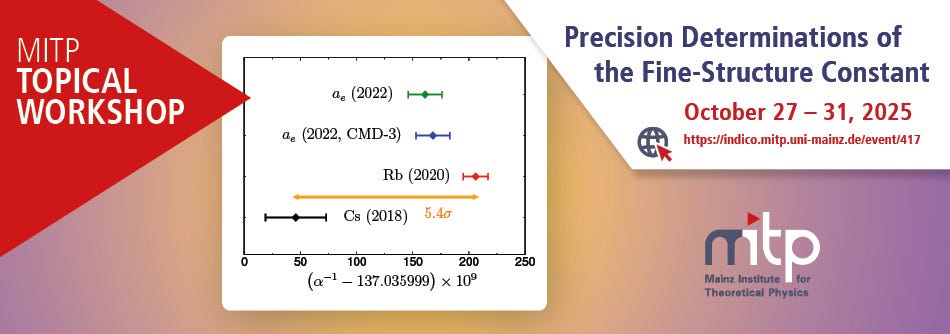
Everybody at that conference aims to achieve higher measurement precision. The coming years should bring progress and clarity, because the results of the different groups do not overlap.
On the other front, in the efforts for the calculation of 𝜶 ab initio, something interesting happened already in 2004. In that year, Hans de Vries published a formula for alpha that agrees with measurements so far. He was writing a book on quantum electrodynamics. While doing so, he guessed an expression that reproduces all measurement averages to this day. De Vries’ expression
predicts
𝜶_predicted = 1/137.035 999 095 829 70…
Note that the expression only contains e and 𝞹, exactly as many researchers demanded. De Vries’ guess was the result of an amazing and refreshing intuition.
When ou Kauffman and I saw de Vries’ fomula about a year ago, we thought directly that we should be able to derive it from the strand model. And we managed to do so. Our article, linked below, deduces the formula from the strand tangle model for the electron and for the photon.
One notes directly that the two measurements cited above appear to disagree with the expression by de Vries; one disagrees by 10 sigma, the other by 5 sigma. However, the de Vries prediction does not disagree with other measurements, and it agrees with the world average 137,035 9991(1).
In short, we have a numeric prediction that can be checked with experiments. Future measurements should settle the issue. We live in interesting times. (And yes, I believe that spending money on several experiments measuring the fine-structure constant to high precision should have top priority in research spending about the foundation of physics – all over the world.)
In future, a further point that needs to be explored is the energy dependence of the fine structure constant, its so-called running. Strands predict that the value should increase with energy. We are working on this topic. Also many other aspects of the strand model are fascinating, and we still have to decide which one to explore first.
*
The way to calculate the fine structure constants from strands is told this new article, from July 2026:
Louis Kauffman & Christoph Schiller, How come the quantum? From the topological origin of Planck’s quantum of action to the fine-structure constant, https://zenodo.org/records/21467195. It derives the above formula by de Vries from strand geometry. The paper contains many additional explorations.
Note that only a few proposals to calculate the fine structure constant from a model that describes nature are available in the research literature. And the other approaches all predict new effects, or new particles, or new forces – none of which have been observed yet. Future will tell.
* * *
Stunning!🎯