
How long is a tight knot?
A child's question that no mathematician and no Ai system has solved yet
Imagine a rope of constant radius that is infinitely flexible. Tie a tight knot into it. By how much did the ends of the rope come closer?
In other terms, find a formula to calculate the length of a tight knot in a rope.
Mathematicians call this the ropelength problem. It is unsolved for every non-trivial knot! The problem is unsolved for open knots (as in the figure) or for closed knots (as mathematicians like to define them). Only computer approximations to the ropelength exist. A formula does not. Clearly, different knots have different ropelengths:
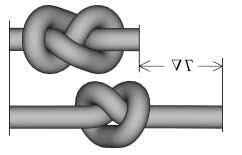
In simple words, nobody in the world has a clue for the solution of the ropelength problem, despite the efforts of several mathematicians who have spent their lives on the problem.
The ropelength problem is fun
(1) A famous knot theorist humorously called the lack of solution a “shame” for the whole field of knot theory, and even a shame for mathematics as a whole.
(2) A few days ago, in early February 2026, I posted the problem on social media as a challenge for Ai systems. One big and proud mathematics Ai project - which I do not want to name here - wrote me back and stated that the problem was “ill-defined” and asked me whether I could provide a “reference”. Now, if an Ai system is even unable to find a wikipedia article, will it be able to solve the mathematical problem described in that article? I doubt it.
(3) Other Ai projects might succeed. One of them even liked my social media post. It will be fun to see what happens.
Mathematics has many beautiful and simple open problems. The ropelength problem might well come out at the top.
The ropelength problem is interesting
Apart from testing the abilities of mathematical Ai systems, the solution to the ropelength problem would be of interest because solving similar geometrical problems would solve the main open issues in fundamental physics.
Is it artificial or absent intelligence?
The ropelength problem is a typical research problem that cannot be solved by reading the literature. Some new insight is necessary. Just ask your favorite Ai system: “Can you provide formulae for the ropelength of the open and the closed overhand knot?”
Is Ai absent innovation?
This specific question is highlighted by the ropelength problem. It is not required that mathematical Ai systems be like Ramanujan. (Though that would be fascinating, of course.) But can Ai systems produce any innovation at all?
*
References
The image is from P. Pieranski, S. Przybyl, A Stasiak, Tight open knots, The European Physical Journal E 6 (2001) 123-128, doi 10.1007/s101890170012, and is also found on ResearchGate.
The wikipedia article on ropelength is here: https://en.wikipedia.org/wiki/Ropelength. Some papers follow.
On the Minimum Ropelength of Knots and Links: https://arxiv.org/abs/math/0103224.
Tight open knots: https://www.researchgate.net/publication/225672330_Tight_open_knots.
The shapes of physical trefoil knots: https://www.sciencedirect.com/science/article/pii/S2352431621000043.
More questions that check the abilities of Ai systems are here: https://www.motionmountain.net/tiny.html#Ai. At present, they all disappoint - deeply.