
It might surprise you, but nature provides a limit to jerk. Clearly, everything in nature is limited in one way or another. For example, the fact that the sky is dark at night is proof that the universe has a finite size. The finite size is a limit to distances and lengths.
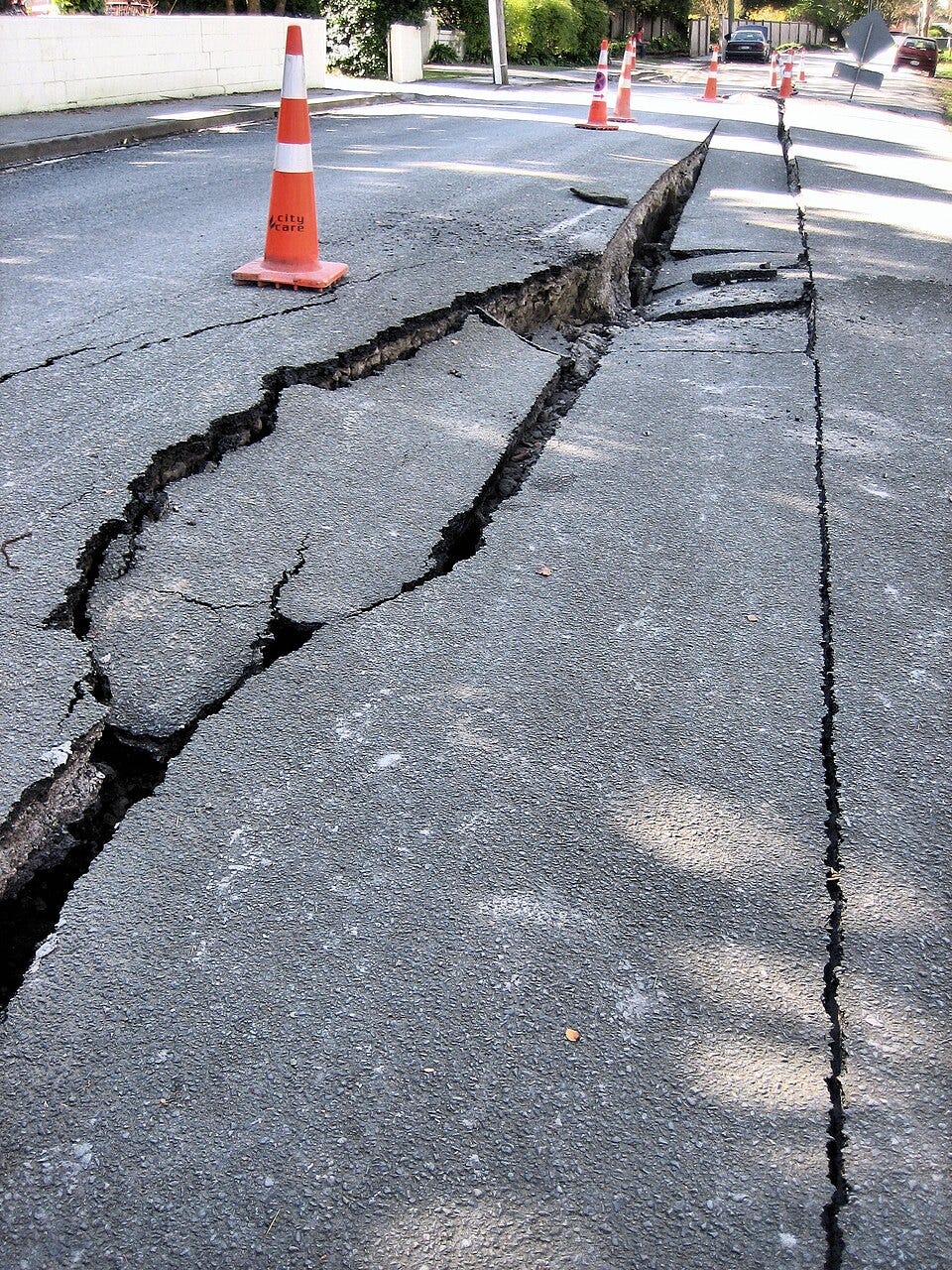
(Image of an earthquake damage by Martin Luff, via Wikimedia)
Nature also has a limit to jerk. In American English, it has become common to (humorously) use the term jerk, which is usually abbreviated as j, for the time derivative of acceleration:
Like all quantities, it has a Planck-scale limit. The limit is
Like all higher time derivatives of acceleration, jerk has no practical use in the description of nature. Except one.
The internet gives a platform to many strange opinions. This includes the mistaken opinion that physical systems - or nature - can exceed the Planck limits. This is wrong.
Sometimes, the Planck mass is cited as an argument. But the Planck mass only limits elementary particle mass. And indeed, all elementary particles have smaller mass values than the limit.
In reality, there is no experiment whatsoever that allows trans-Planckian values to be achieved, to be measured or even to play a role in nature. Trans-Planckian quantities simply do not exist in nature. They are as real as pink flying elephants.
In fact, all measured jerk values are much smaller than the limit. Earthquakes can reach 300 m/s^3 - and such then lead to effects as those shown in the photograph above. Macroscopic jerk values are rarely larger than 10^5 m/s^3. Such values are found in crash tests and mechanical failures. For particles in accelerators, values in excess of 10^20 m/s^3 are achieved. But all these values are much smaller than the theoretical limit given above.
In other words, whenever you encounter a jerk, recall that every jerk is limited. This realization will greatly increase your quality of life.
*
A literature reference on the jerk limit is Physical Review D 104 (2021) 124079.