
Understanding quantum measurements
using the fundamental principle of the strand tangle model
“Nobody understands quantum mechanics.” Wrong. “We do not know what a measurement apparatus is”. Equally wrong.
A measurement apparatus, such as a photon screen, is a device with a memory: it starts in one state and ends up in another. A system with a memory must have a bath built-in, i.e., a system with many particles described by a temperature. Such an apparatus is therefore automatically irreversible or, as often stated, it is ‘classical’.
The fundamental principle of the strand tangle model shows the details of what happens during that process.
As told in previous posts, the fundamental principle of the strand tangle model reproduces quantum theory and general relativity. But it also visualizes both, and in particular, the measurement process. This is best explained with photons.
The fundamental principle led, as told in previous posts, to describe a photon as an unobservable strands with a rotating twist (or loop). For a photon in a typical state, the loop has roughly the size of the wavelength and rotates with the photon frequency. For a coherent superposition of several states, the situation is more involved.
The picture below, on the left, shows a snapshot of a (blue) photon strand after it passed a double slit:
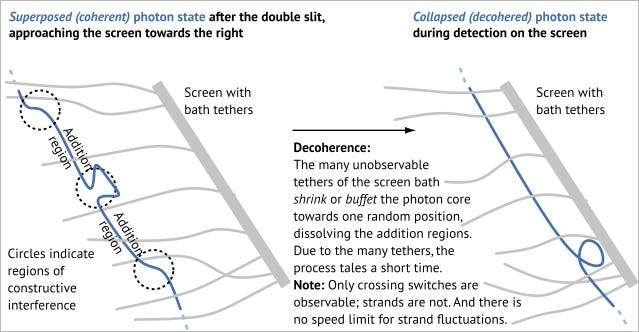
A photon detection is only possible where the strand is curved, because in the strand model, only crossing switches are observable, and they can only occur at curved segments. Straight strands are unobservable.
When the photon strand from the double slit approaches a detection screen, the many tethers from each of the screen particles continuously touch and push the photon strand. The detector tethers buffet the photon strand. This buffeting collapses the photon strand to a loop at a single position, concentrating all curved sections at one region of space. (One also speaks of decoherence.) After the collapse, the localized loop hits an electron and is detected.
The buffeting process explains where there is only one measurement result. It explains why the measurement result is random: the result depends on the fluctuations of the photon and of the apparatus. The buffeting process also explains why decoherence takes time, and why the time depends on the temperature of the bath - as is observed. The buffeting process also explains why decoherence appears to be superluminal: strands fluctuate with no speed limit.
In simple words, strands explain and visualize the measurement process in all its aspects.
More details on this story are found at www.researchgate.net/publication/361866270 .
*
Amazing way to show your work! Congrats for the paper !