
So far, the strand tangle model, or tiny theory, has explained why there are three dimensions, three gauge interactions, and three particle generations. The tiny theory has explained the origin of wave functions, the symmetries of the gauge interactions, the quantum numbers of all elementary particles, the equivalence of inertial and gravitational mass, black hole thermodynamics, and general relativity. The tiny theory has deduced the Lagrangian of the standard model of particle physics, roughly estimated particle masses, predicted the normal sequence of neutrino masses, and ruled out inflation, the multiverse, and physics beyond the standard model. Recently, the tiny theory deduced the fine-structure constant to all (agreed) measured digits. The tiny theory is falsifiable in all its statements. Nevertheless, all consequences follow from a single fundamental principle. (See the references. at the end.)
This is satisfying, but one thing is missing: strands provide no unified equation.
How can a theory describe both quantum theory and general relativity, thus unify physics, without providing a unified equation?
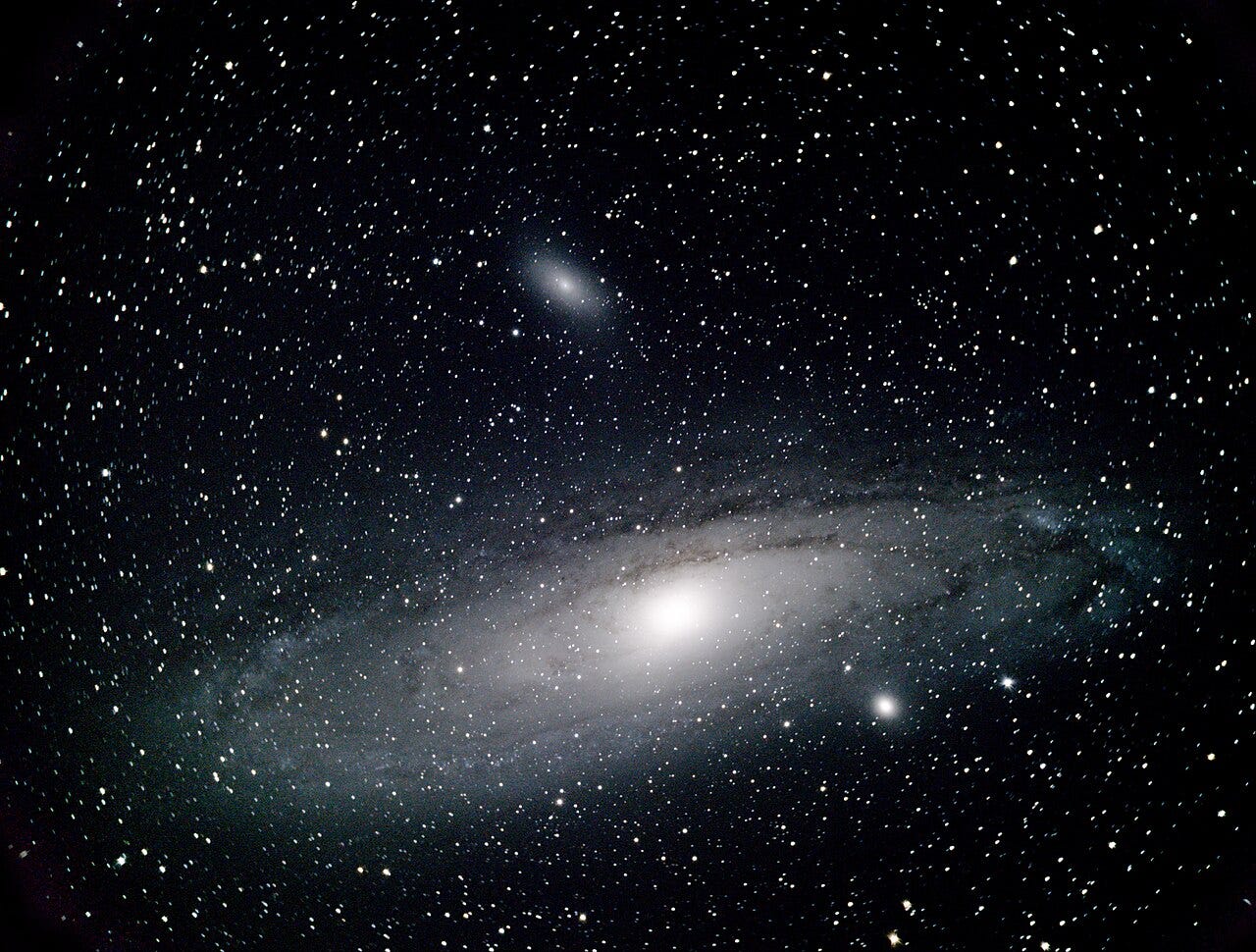
(Photo by Parker Bossier, via Wikimedia)
It turns out that unifying physics eliminates the possibility of a unified equation. Though strands make this point especially clear, the arguments are general, and they are independent of the details of the unified theory.
Any equation describing all of nature requires an outside observer. This is impossible. We are part of nature. A global equation describing all of nature is impossible. But what about the fundamental constituents of nature, whatever they might be? Is there a unified equation for these constituents? Is a local equation possible?
In textbook physics, space and particles consist of points. In textbook physics, points are the fundamental constituents of nature. We use points to deduce local descriptions. But points are not observable. Besides that, points have very few specific properties. Therefore, one can invent many theories based on points. Indeed, there are hundreds of possible physical theories. Alas, none of them explains the number of dimensions, the number of interactions, the number of elementary particles, or the thermodynamics of black holes.
In full contrast, strands explain the properties that are unexplained by points. But we pay a price.
Strands, like points, are fundamental constituents. And all fundamental constituents are unobservable. It is easy to check that any fundamental constituent must be unobservable: after all, it must yield empty space, and no experiment has ever observed constituents of empty space. As a result, no equation for fundamental constituents can be tested against observations. If one cannot test such an equation, one cannot state that such an equation is possible.
But there is an even stronger objection. Any fundamental evolution equation for a strand or any other fundamental constituent would need to describe the detailed influence of all of nature, the rest of the universe, on the constituent. This is impossible. In contrast to everyday life, strands, like all alternative fundamental constituents, do not have an environment that can be ignored. No fundamental constituent can be isolated from its surroundings. Fundamental constituents are never alone. Therefore, one cannot find an equation that describes their evolution.
In quantum theory, the lack of local (or non-contextual) hidden variables also prevents a unified equation. But this is a highly technical argument. In simple words, nature is probabilistic, and local equations reproducing this property are impossible, because they contradict observations.
In physics, all equations of motion are based on physical observables., such as force, magnetic fields, probability denisties, etc. Because the fundamental constituents of nature are not observable, there is no way to even think about a fundamental equation of motion. But we can say more. All physical observables are emergent. Textbook physics does not realize this aim, because no evolution equation does so. In textbook physics, all evolution equations are based on the distinction between points and observables. To put it in a provoking manner, mathematics invented points and physics invented the observables that describe nature. This works very well, as we all know (there is no deviation between theory and practice in modern physics), but the approach cannot explain why nature is as it is. Points are not specific. A full explanation of nature needs to explain physical observables as emerging concepts. Points prevent this. Strands solve the problem.
When Euclid defined a point as “that which has no parts”, he made clear that the concept of point is a reductionist concept. But this approach cannot be correct. At the foundations, the constituents of nature cannot be isolated. And observations confirm this directly. The minimum action in nature, the highest speed in nature, and the maximum force in nature, when combined, imply that points do not exist. (Equivalently, the entropy and the temperature of black holes imply that points do not exist.) These Planck limits, when combined, imply that nature has a minimum length. With a minimum length and without points, there are no equations.
In simple words, a unified equation, thus a unified local description, is impossible because everything is related to everything else. Now, this may sound familiar. We all have read arguments claiming that a unified theory of nature is impossible because we are, ourselves, part of nature. But there is a difference: the arguments just given prevent the existence of a unified equation. The arguments just given do not prevent unification itself.
In short, whenever people talk about a unified equation, or a core equation, or a God equation, or a “world formula”, you directly know: they have not thought about the topic and are just drawing attention to themselves by talking nonsense. The Planck limits of nature also limit reductionism, and imply:
A falsifiable, unified equation is impossible.
In contrast, a falsifiable, unified theory is possible.
A unified theory needs to abandon points and equations. It needs to take into account the minimum length in nature. And such a unified theory appears to be available, as suggested by the tiny theory, also called the strand tangle model.
*
References:
How come the quantum? Testing the topological origin of Planck’s quantum of action, by L.H. Kauffman and C. Schiller, available at zenodo.org/records/19628907
Testing the tiny theory: a single fundamental principle yielding general relativity, particle physics, and gauge anomaly cancellation, by C. Schiller, available at https://www.researchgate.net/publication/397264142.
* *
Please come check out January “Janus” Walker on Tik Tok 8pm PST, and here is her work at http://INFOTON.ai and her email is January@infoton.ai
My first reaction was that you should go nuts that I'm trying to dismantle quantum mechanics. Try reading these two articles and blow your mind experiments validate facts they don't validate theories. And: unmasking quantum mechanics: when did magic become science? With any luck it will open up your mind to how difficult the task is going to be to take on climate change if we don't first fix science