
What is particle motion?
Particles move through the vacuum like tethered maple seeds through the air.
How do particles move? In the past hundred years, the idea was that point particles move through points of space. Indeed, for over a hundred years, quantum theory has modeled particles as point particles, and general relativity has modeled curved space as being built from points. This approach is based on invisible and unobservable points, as formulated by Euclid 2300 years ago. However, as a consequence of being based on points, this approach cannot explain the appearance of the quantum of action ħ and of the speed limit c, of the gravitational constant G, and of Boltzmann’s constant k. Likewise, the approach cannot explain the properties of point particles, such as their masses and couplings, and cannot explain why points form a space with three dimensions.
Worse, today we know that the idea of point particles moving through space points is wrong: there is a minimum length in nature, given by the Planck length. So we know that there are no points. And we also know that nature has wave functions. So, what is the correct description of the motion of a single particle through space?
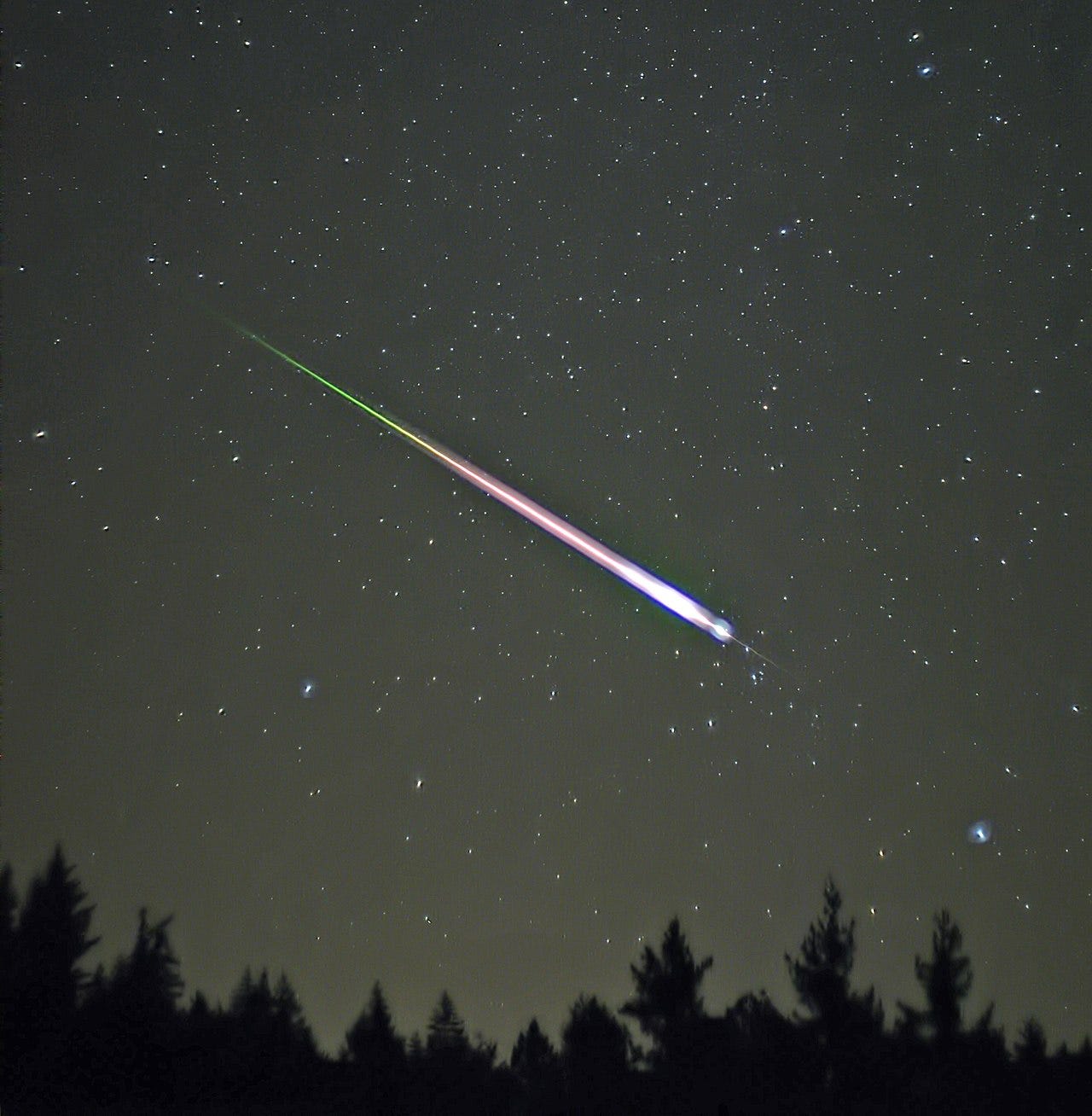
(Photo by Navicore, via Wikimedia)
The nature of particle motion requires a description of what happens at the boundary between a particle and the surrounding space. Today, particles are described by quantum theory and space by general relativity. Thus, the answer to the question about particle motion requires quantum gravity! And, as we all know, that is still a topic of research.
Let us start from the beginning. What can move in nature? Only three systems move: particles, space, and horizons. Because black hole horizons have entropy, they are made of constituents. Because black holes can be said to be both curved space and many compressed particles, all three moving systems must consist of the same constituents.
Because black hole entropy is proportional to their area, they must be made of filiform constituents without ends. Because black hole entropy contains the Planck area, the constituents must have Planck cross-section. Because the constituents have Planck cross-section, they are invisible. Because the invisible constituents - called strands - also form space and particles, space must consist of untangled strands and particles of tangled strands. The tangled regions are observable and form the wave function. In each particle tangle, the strands connect the particle core to the cosmological horizon. The connections of each particle to the cosmological horizon determine its spin and its statistical behaviour.
The invisible strands constantly fluctuate, being pushed by neighboring strands. These fluctuations yield the entropy of black holes (and of curved space) and the wave function of particles. Tangles also yield spin 1/2, as Dirac showed in 1929.
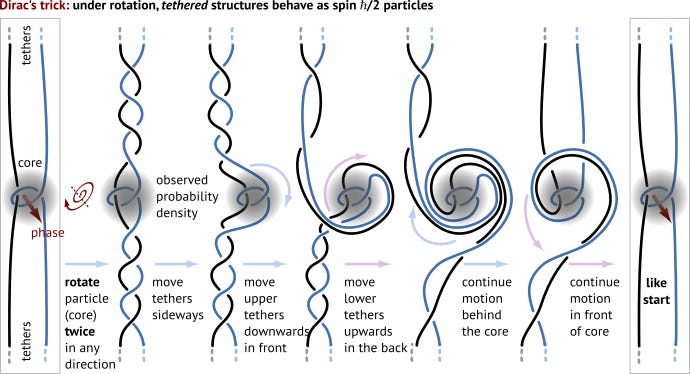
As a consequence, particle motion is a sequence of Dirac’s belt tricks, also called string tricks, in a sea of untangled vacuum strands. This description supersedes the old, conventional idea that particles are points moving through a sea of vacuum points. When moving, the core of the tangle (see image) moves like a maple seed or a pinwheel moving through the air. Particle cores move like little propellers, and the strands connecting them to the cosmological horizon continuously perform Dirac tricks. In particular, this description, when contracted to a point and when recalling that the connections are unobservable, yields Feynman’s description of a particle as moving, rotating arrow.
Can this description be tested? Yes. Describing particle motion as a sequence of Dirac’s tricks in a sea of untangled vacuum of Planck radius strands also models the minimum length, explains the existence and the properties of wave functions, and explains the three-dimensionality of space. And strands allow even more tests: strands explain the known forces and the known elementary particles. In fact (see the references below), tangled strands imply and explain the Lagrangians of general relativity and of particle physics, including massive neutrinos, in all details. No other approach yields these explanations. In addition, as required above, strands also explain the quantum numbers of all particles, the particle masses, the gauge coupling constants, and the mixing angles. And these are the main open questions in modern physics.
In short, quantum particles move like tethered propellers continuously performing Dirac tricks. At present, strands provide the only known way to describe particle motion in accordance with all experiments, to describe quantum gravity in accordance with all experiments, and to deduce all of physics in accordance with all experiments.
*
A short preprint about how the strand tangle model deduces all of physics is researchgate.net/publication/397264142, a long prprint is researchgate.net/publication/361866270. Enjoy.
* * *
Interesting take on motion and horizons. Leveille sees black-hole horizons as never reaching exact closure — the scar (Δ > 0) keeps the interior regular. Paper 58 is the clean overview. No paywall archive: exactlyinfinite.substack.com