
Why new quantum gravity effects will never be observed
And what to do instead.
Imagine that we already had a correct theory of (relativistic) quantum gravity. The correct theory of quantum gravity has two main consequences: general relativity and particle physics. But does it have more consequences, in particular, does it have new, unexpected, experimentally testable consequences?
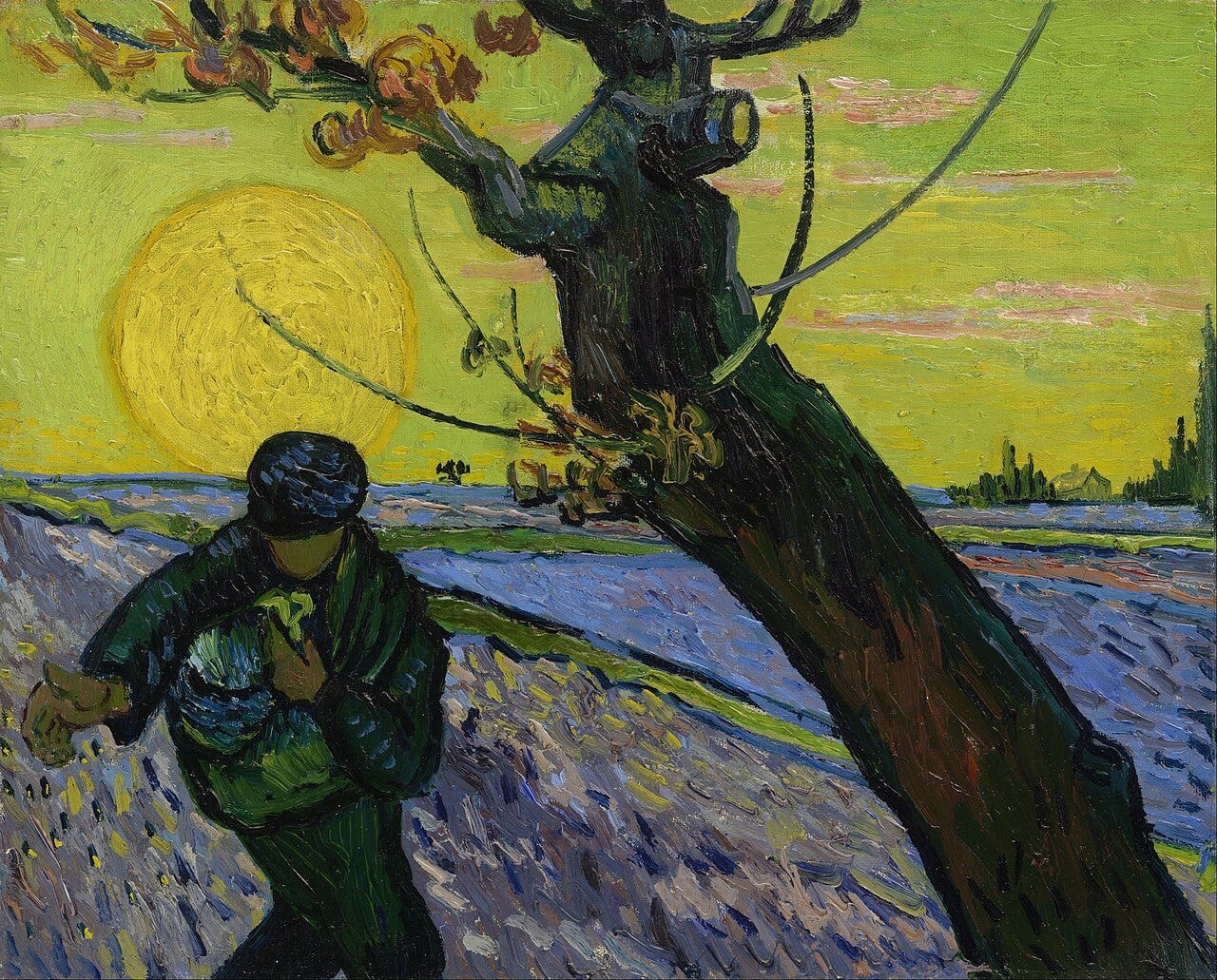
The Sower - by Vincent van Gogh
The theory of (relativistic) quantum gravity describes, as the name says, the quantum effects of gravity. Quantum effects are all those effects that contain Planck’s quantum of action ħ. In the case of gravity, this would include quantization of length, area or time, which might arise at the Planck scale. However, the smallest possible measurement errors in nature are of the same Planck size. In other words, there is no way to detect the quantization of space and time.
For example, many papers have discussed that gravitons cannot be detected one by one. There is no way to detect single gravitons, unlike photons. The fundamental reason: graviton effects are indistinguishable from the effects of quantum theory inside detectors.
As another example, quantum theory produces superpositions, such as particles partly in one position and partly in another. Will they yield new effects for gravity? Of course not: the world around us is already full of superpositions, and nothing surprising was found.
One can also ask the opposite question: are there any observations in contrast with general relativity or with particle physics? No. But wait, the mass media say otherwise. They mention “dark matter”, but it has never been observed to differ from normal matter and black holes. The mass media also tell about dark energy. This topic is in flux, at present. The only thing that is sure, today, in 2026, is that the Nobel Prize for the “acceleration of the universe” was premature.
The exploration can be continued. A relativistic quantum gravity effect is one containing all three constants ħ, c and G. No such effect has ever been measured. Only effects containing one or two of these constants have been measured. And it is a safe bet that no effect with all three constants is detectable.
So, how can a theory of quantum gravity prove that it is correct? In general, it has to derive general relativity (which is easy) and the standard model of particle physics (which is hard). But in particular, a theory of quantum gravity must explain the masses of the elementary particles, the gauge coupling constants, and the mixing constants. This is the decisive test.
The standard model of particle physics does not derive the values of the masses, the gauge coupling constants, and the mixing constants. The values are assumed from the start. However, these values are the only detectable effects of quantum gravity in nature.
In other words, to understand quantum gravity, we physicists have first to measure the constants as precisely as possible. This includes the neutrino masses and neutrino mixing parameters. We should invest as much effort as possible in this task.
Secondly, we physicists have to produce as many theories of relativistic quantum gravity as possible, calculate these numbers, and then compare theory and observations. And yes, this implies that any theory that does not allow calculating these numbers is of no help.
Go for a try! (But do not use Ai. It cannot help.)
*
In one of the next posts, I will present a quantum gravity prediction that has been tested with a precision of 15 digits.
*
In the literature, only two approaches are candidates for quantum gravity, thus deduce general relativity and particle physics and the fundamental constants. (The mass media tell otherwise.) The first approach is the octonion model by Tejinder Singh: see https://arxiv.org/abs/2209.03205; the other is the strand tangle model. A short preprint about the strand tangle model is researchgate.net/publication/397264142 and a long one is researchgate.net/publication/361866270.