
Why there is no alternative to strands in quantum mechanics
With further prizes for candidate counter-arguments
It is argued that quantum mechanics in itself and by itself requires strands. This essay tells why there is no alternative model that yields quantum mechanics. The previous text argued that only strands imply quantum gravity. This essay, in contrast, goes further and argues that conventional textbook quantum mechanics is sufficient to show the necessity of strands.
The fundamental principle of the strand model describes Planck’s quantum of action ħ as a crossing switch of unobservable strands of Planck radius:
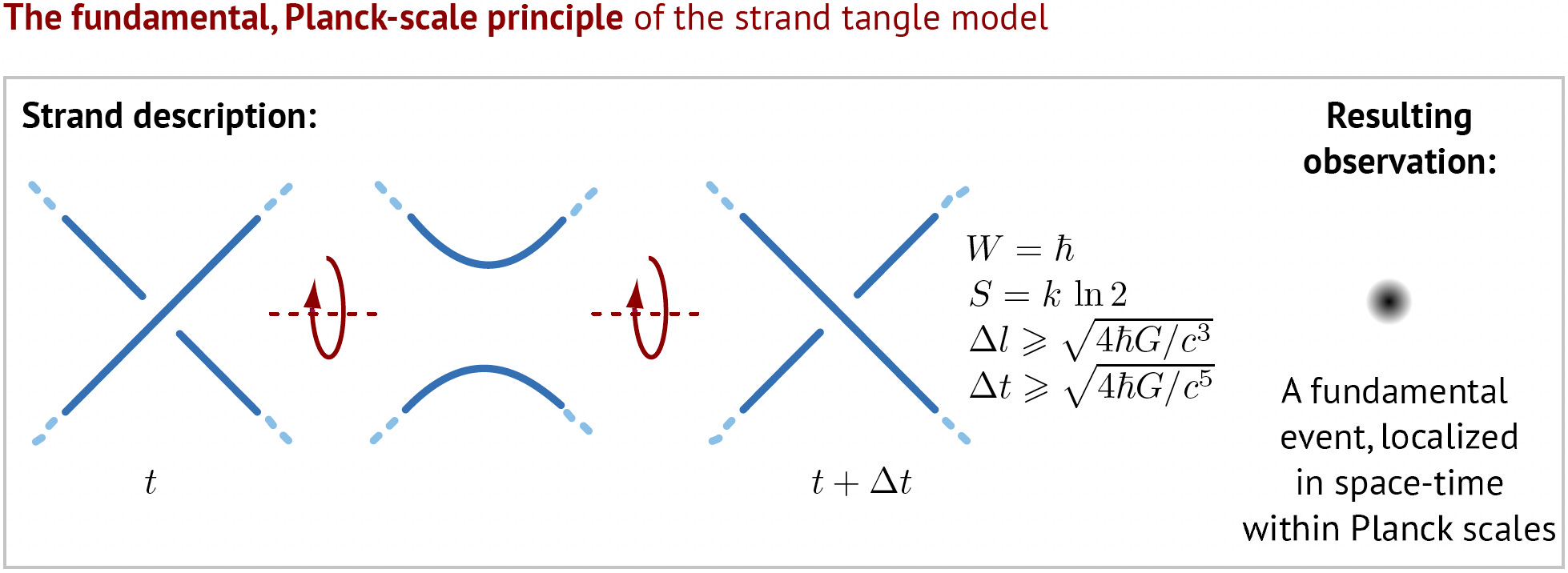
A literature search shows that no other model describes the quantum of action ħ and its effects, despite various attempts. Likewise, no model for ħ has been used or proposed in the literature about emergent quantum theory, causal sets, loop quantum gravity, superstring theory, causal fermion systems, the octonion model, or any other approach to unification. To allow a precise discussion, it is best to start with a
Definition: A model is a visualization in three-dimensional Euclidean space that uses countable constituents for space and for particles that are subsets of 3d space.
This definition is due to the observation that nature is three-dimensional. This definition of a model allows the comparison of alternative models with the strand model for ħ using crossing switches. This comparison is possible for several aspects of quantum mechanics.
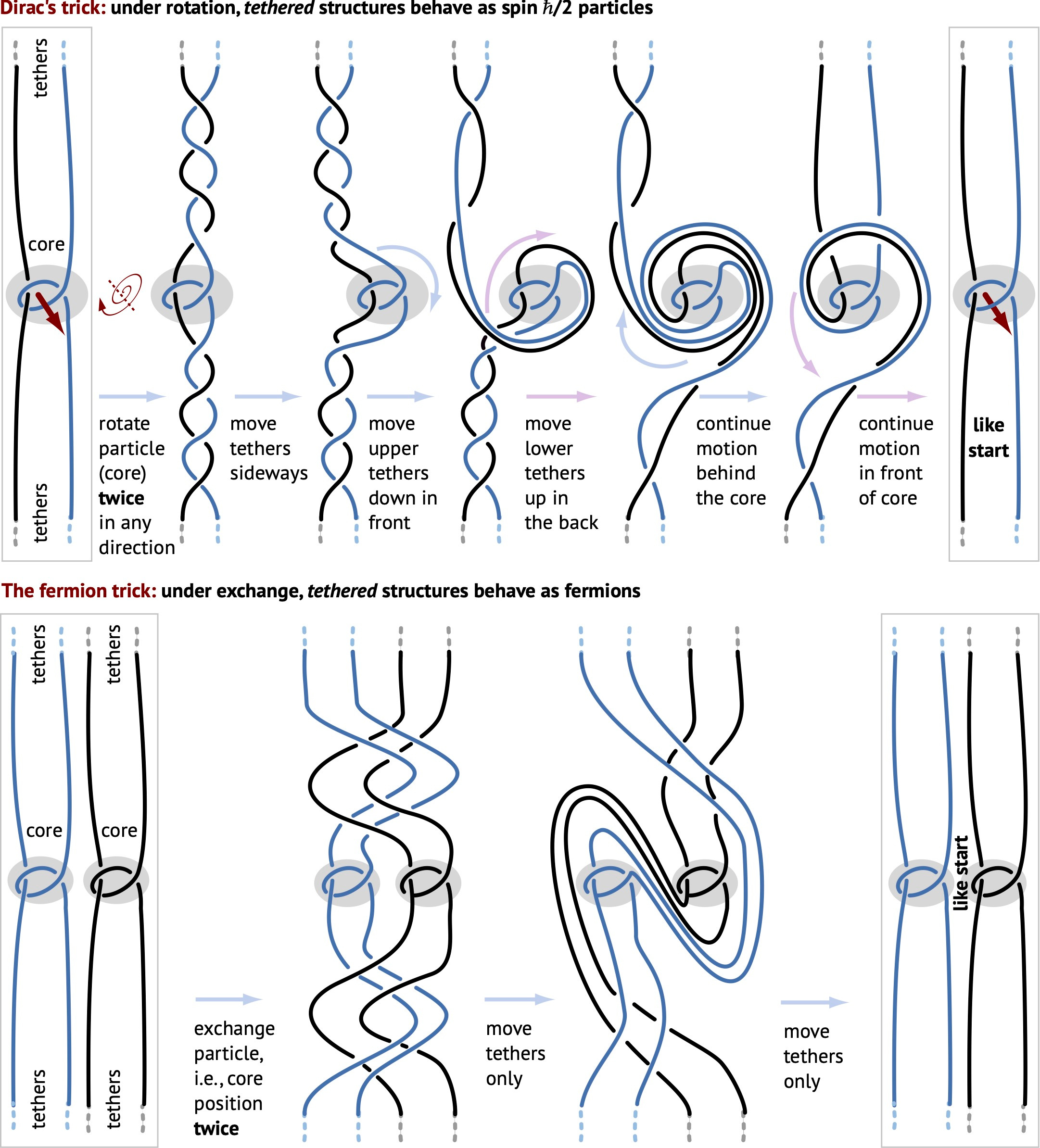
1. As told already several times, tangles of unobservable strands performing both Dirac’s trick and the fermion trick do so in an environment of untangled strands in 3D space. No alternative constituent and no alternative model achieves the visualization and the explanation of spin ħ/2 behavior, of fermion behavior, let alone of the spin-statistics theorem for spin ħ/2 fermions. (Neither the book by Duck and Sudarshan achieves this, nor do the visualizations using the ball B3 in which opposite points are identified, nor the coupled pendula, nor the sphere glowing in different colors.) Above all, no particle model without tethers reproduces the existence of a particle-independent smallest positive value for spin.
The existence of countable elementary particles of different types, including antiparticles and three fermion generations, is a challenge to any model proposal. The challenge is so demanding that only a few models that explain the spectrum of elementary particles using extended constituents have ever been proposed. All such models are based on topology, because only topological particle models have the chance to explain the qualitative differences among particles, such as their different quantum numbers and states, while ensuring the indistinguishability of particles of the same type.
However, topological models for elementary particles face constraints. Because of spin ħ/2, particles must be tethered; they cannot be knots or links of finite size, but must be tangles. In addition, the particle transformations observed in decays and in particle reactions, including particle annihilations, exclude models of particles based on knotted tangles. Therefore, particles must be, topologically speaking, unknotted, i.e., rational tangles. The classification of rational tangles yields that elementary particles can only consist of one, two, or three strands. Tangles of four or more strands are composed of simpler tangles. Elementary fermions of spin ħ/2 can only consist of two or three strands tangled in a non-trivial way. Elementary bosons of spin ħ must be trivial tangles of one strand or specific tangles of two or three strands. One elementary spin-0 boson is also possible.
The topology of tangles determines the quantum numbers. But the cores of rational 3D tangles have, besides their topological properties yielding the quantum numbers, also geometric properties that are due to their shapes. The average geometry of a tangle determines its quantum state; in addition, the average core shape determines mass values, mixings, and couplings. In simple words, among the approaches that agree with all observations, no other model reproduces particles, spin ħ/2, quantum numbers, fermion behavior, unique mass values, mixings, and coupling constants.
It must be noted that proving this uniqueness of strands independently of 3D space remains an open challenge.
2. The quantization of action and of angular momentum are consequences of discreteness. Now, only extended objects can model discreteness, because quantization and discreteness are inextricably linked to extension. Extension, in turn, implies the importance of topology. That is the reason that in the strand tangle model, at the Planck scale, the discreteness of action and of angular momentum are due to three-dimensional topology, even though the discreteness of space and time is unobservable. Dirac’s belt trick for fermion tangles realizes this connection. A literature search for other possible models yields a simple but clear result: No other model apart from the strand tangle model explains the quantization of angular momentum and the quantization of action.
3. In the strand tangle model, wave functions are oriented crossing densities of fluctuating tangles. In the literature, no other model explains and visualizes complex wave functions. Likewise, no other type of constituent deduces wave-particle duality and the Schrödinger equation ab initio. Generally speaking, no alternative specific model for the emergence of quantum mechanics is available in the literature, despite numerous investigations. Combining countable particles with an (almost) infinite-dimensional Hilbert space requires an (almost) infinite number of configurations or shapes; this is only possible using strands. For example, fluctuating membranes do not reproduce quantum interference, and neither do fluctuating constituents that are Planck-sized or of finite size in all three dimensions. In simple words, apart from oriented crossing densities, no other model for wave functions combines particle discreteness with continuous probability densities.
4. Strands describe quantum jumps as almost discrete processes. Several publications showed that the strand description of photons and their coupling to tangles reproduces quantum electrodynamics, without any measurable deviation, but including the g-factor of the electron. The literature provides no other description of electrodynamics or of quantum jumps. In simple words, at the Planck scale, no alternative description for quantum jumps is currently known.
5. Strands explain and visualize the non-commutativity of quantum observables. No model that uses continuous fields can yield non-commutativity, countable particles and discrete action values. In particular, the non-commutativity of rotations and of particle exchange can only be modeled with a topological model based on strands. In contrast, deformations of constituents with ends, with finite size, with closed strands, or with membranes are commutative. In simple terms, no model other than strands without ends reproduces non-commutativity.
6. The maximum speed, the maximum force, and the quantum of action, taken together, imply that there is a smallest measurable length and that space is fuzzy at Planck scales. (The surface dependence and the magnitude of black hole entropy imply that horizons consist of countable fluctuating strands of Planck radius without ends, without branches, and without knots. Because black holes can form by collapsing particles, particles must also consist of fluctuating strands.) The strand shape fluctuations lead to the fuzziness of quantum mechanics. In simple words, only fluctuating strands explain Heisenberg’s indeterminacy relation and the appearance of probabilities in the quantum domain.
7. Visualizing quantum entanglement with topological models is an old dream. Attempts so far do not reproduce all the observed properties of multi-particle entanglement. Apart from strands, no past approach (bit threads, Borromean rings, etc.) provided a complete description of entanglement, of ħ, or of the relation between the two. Only strands have a topology that allows multi-particle entanglement in complete agreement with observations. In simple words, no model other than strands explains and visualizes quantum entanglement.
8. Strands model photons. A similar model for photons, the unpublished “schmoton” model, is found on the internet. That model, however, lacks the identification of ħ with a crossing switch. Despite numerous attempts, no other model accurately describes electromagnetic waves as composed of discrete photons. In simple terms, no model other than strands describes the countability of photons, their spin ħ, their boson behaviour, their wave behaviour, and all their other properties.
9. Modeling the probabilistic outcomes of quantum measurements with a partially discrete and partially continuous substructure that differs from strands but reproduces particles has not been successful so far. Only observable crossing switches of unobservable strands reproduce Born’s rule, the collapse of the wave function, and decoherence. In simple terms, only observable crossing switches of unobservable strands eliminate hidden non-contextual variables and reproduce wave functions.
10. Deducing the Dirac equation from deeper principles is challenging because of the difficulty of encoding spinor behavior and antiparticles. Apart from Battey-Pratt and Racey’s approach (presented in the preprint at the end), several attempts to derive the Dirac equation from an underlying discreteness have been published. (They are listed by Simulik in his book.) None starts at the Planck scale. In simple terms, only rational 3D tangles yield spinors, yield continuous transitions from particles to antiparticles, and deduce the Dirac equation ab initio.
11. The fundamental principle implies that the principle of least action is the principle of the fewest crossing switches. Because of the coupling of crossing switches to photons, strands also explain the principle. A literature search shows that no alternative model for the principle is known, mainly because no alternative visualization, model, or explanation exists for photons and for quantum measurements. In simple terms, no model other than strands explains the principle of least action.
In summary, the strand tangle model appears to be the only model that reproduces wave-particle duality. It appears that no alternative model to crossing switches of strands explains, visualizes, or describes Planck’s quantum of action ħ or quantum mechanics. Therefore, quantum mechanics requires that elementary particles have tethers. Finding an alternative model or a definite counter-argument to any of the above points would immediately falsify the strand model.
*
If you found or suspect a loophole in the above arguments, let me know. As usual, for each good candidate loophole, the first sender will get a dinner invitation.
An introduction to strands in quantum mechanics and in quantum theory is here: https://www.researchgate.net/publication/361866270.
For completeness, the strand model is the description of nature with fluctuating strands of Planck radius, for which crossing switches define Planck’s quantum of action ħ. It is a candidate for quantum gravity. Details are found at www.motionmountain.net/tiny.html and www.motionmountain.net/research.html. The pages explain how strands imply general relativity and the complete standard model of particle physics, including the particle spectrum, the gauge interactions, and the fundamental constants.
* * *